In a continent where climate change is accelerating faster than global averages, the internet is becoming more than a communication tool , it is emerging as a lifeline. Across Sudan, Ethiopia, South Africa, and beyond, young Africans are turning digital platforms into hubs of climate knowledge, mutual aid, and rapid-response advocacy. These online spaces are transforming how communities mobilize, learn, and protect themselves in the face of environmental crises.
A recent Afrobarometer survey shows that 72% of Africans under 35 rely on social media as their primary source of climate information, a significant leap from just 29% a decade ago. “Digital communities are becoming the new climate classrooms,” says Dr. Aisha Mogahed, a digital governance researcher in Nairobi. “People are learning adaptation strategies not through government channels, but through WhatsApp groups, TikTok explainers, and hyperlocal Facebook pages.”
During the 2023 Sudan floods, community-led Telegram channels with over 180,000 members coordinated real-time rescue information, shared safe routes, and helped locate missing people. These groups often moved faster than official agencies. In Ethiopia, TikTok creators such as @GreenYouthAddis have gained traction by teaching micro-adaptation skills, like flood-proofing small homes or building water-efficient gardens, garnering millions of views across East Africa.
Meanwhile in South Africa, digital mobilization has become an undeniable political force. The #GreenOutTuesday movement, started by high school climate activists, spread across X and Instagram and achieved over 14 million impressions in 48 hours, forcing local municipalities to publicly address water shortages and waste mismanagement. Digital pressure has also pushed the Department of Environmental Affairs to publish more transparent climate data, making South Africa one of the most digitally accountable countries in the region.
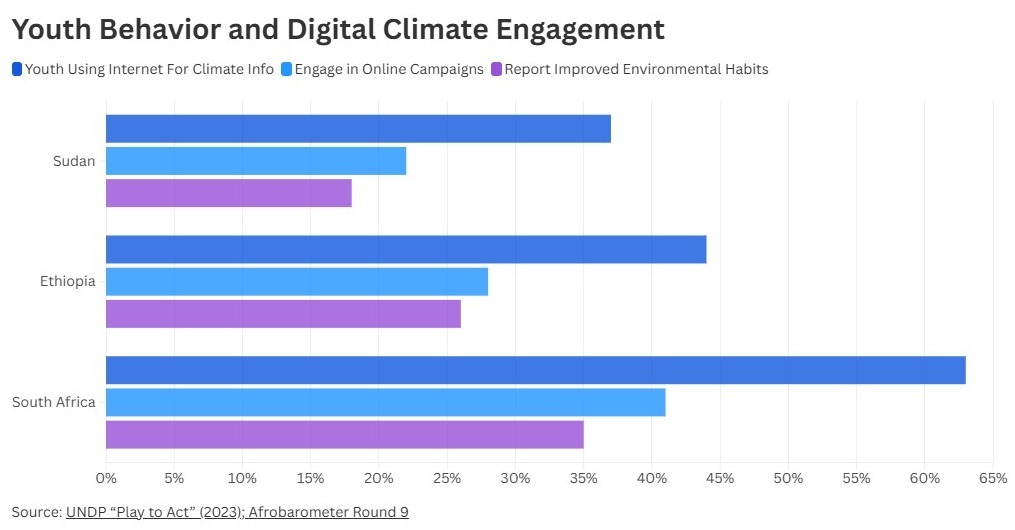
These online communities aren’t just spreading information , they’re changing behaviors. UNDP’s Play to Act initiative found that 79% of players who engaged with green-themed games reported taking at least one positive climate action, from reduced energy use to greener consumption choices. When young people see each other take action online, it creates what activists call a “digital ripple effect”: small behaviors multiplying into large movements.
Still, challenges remain. Access gaps persist, especially in rural Sudan and Ethiopia where connectivity is limited. Digital misinformation, particularly climate denial content, spreads quickly. And many grassroots activists risk surveillance or intimidation when mobilizing online. But despite these barriers, digital climate communities continue to grow in number, sophistication, and influence.
“People think climate activism begins with protests,” says South African climate organizer Naledi Jacobs. “But today, the first rally happened online. That’s where awareness forms, where pressure builds, where solidarity grows.”
From crisis coordination to climate education, from community storytelling to cross-border advocacy, Africa’s digital public squares are proving to be powerful catalysts for resilience. The internet, once seen as a luxury, is now becoming one of the continent’s most important tools in the fight for climate justice.
As Africa steps deeper into an era of climate uncertainty, one truth is becoming clear: our digital connections may be just as important as our physical ones. And in the struggle for climate justice, they may be the strongest lifeline we have.
By : Leena Eisa
This WanaData story was supported by Code for Africa and the Digital Democracy Initiative as part of the Digitalise Youth project, funded by the European Partnership for Democracy (EPD)